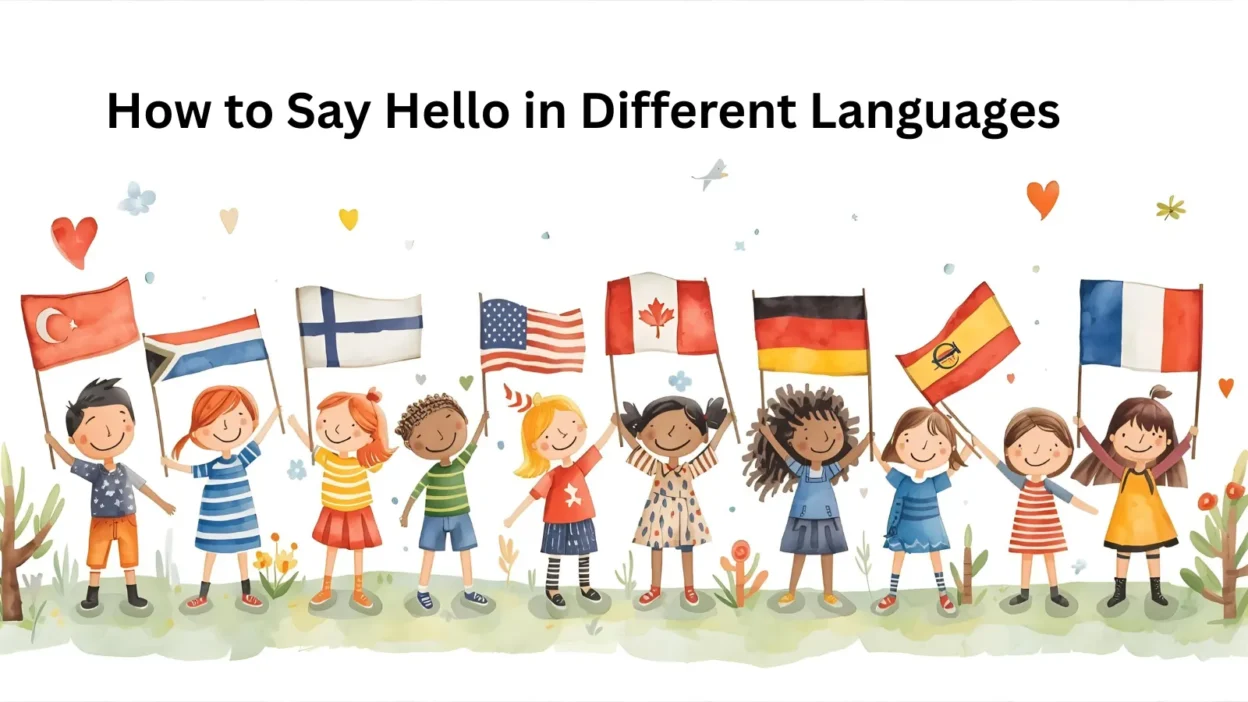
Learning how to say hello in different languages is a fun and easy way to connect with people around the world. Hello may be a small word, but it carries warmth, respect, and friendliness in every culture.
Whether you’re traveling, chatting online, or just curious about other countries, knowing how to greet someone in their own language helps you make a great first impression.
It also shows interest in their culture and builds instant trust. So, let’s explore how to say “hello” in 15 amazing languages!
In this guide, you’ll learn how to say hello in different languages, understand what each greeting really means, and see how to use it naturally — with examples, pronunciation, and cultural notes.
Hello in Different Languages
How to Say Hello in Different Languages
| No. | Language | Phrase | Pronunciation | Meaning / Usage |
|---|---|---|---|---|
| 1 | French | Bonjour | bon-zhoor | “Good day” – polite greeting for morning or afternoon. |
| 2 | Spanish | Hola | oh-lah | Casual and universal greeting in all Spanish-speaking countries. |
| 3 | Italian | Ciao | chow | Used for both “hello” and “goodbye.” |
| 4 | Japanese | Konnichiwa | kon-nee-chee-wah | Used in the afternoon; formal and polite. |
| 5 | Korean | Annyeonghaseyo | ahn-nyong-ha-se-yo | Formal and respectful; used in everyday conversation. |
| 6 | German | Hallo | hah-loh | Friendly, casual greeting in Germany and Austria. |
| 7 | Arabic | Salaam | sah-lahm | Means “peace”; used alone or as “As-salamu alaykum.” |
| 8 | Hindi | Namaste | nah-mah-stay | Respectful greeting with folded hands; means “I bow to you.” |
| 9 | Chinese (Mandarin) | Ni Hao (你好) | nee how | Polite, everyday greeting in Mandarin. |
| 10 | Russian | Zdravstvuyte (Здравствуйте) | zdrah-stvooy-tyeh | Formal greeting for elders or formal settings. |
| 11 | Turkish | Merhaba | mehr-hah-bah | Polite and universal in Turkey. |
| 12 | Hungarian | Szia | see-ya | Casual greeting for friends and peers. |
| 13 | Zulu | Sawubona | sah-woo-boh-nah | Means “I see you”; warm and cultural greeting. |
| 14 | Hebrew | Shalom | shah-lohm | Means “peace”; used for both hello and goodbye. |
| 15 | Swedish / Danish | Hej | hay | Simple and casual greeting used in Scandinavia. |
🇫🇷 1. Bonjour – French
Origin:
From “bon” (good) and “jour” (day), bonjour literally means “good day.”
Example:
👤 A: Bonjour, Madame Dupont!
👤 B: Bonjour, Pierre! Comment ça va?
Use:
Standard and polite. Used from morning until evening.
Cultural Tip:
In France, always greet before speaking — not saying bonjour first can seem rude.
🇪🇸 2. Hola – Spanish

Origin:
From Old Spanish meaning “stop” or “attention,” hola evolved into a warm everyday greeting.
Example:
👤 A: ¡Hola! ¿Cómo estás?
👤 B: ¡Muy bien, gracias!
Use:
Universal and casual; common in Spain and Latin America.
Cultural Tip:
Add a friendly tone and smile — Spanish greetings are full of warmth.
🇮🇹 3. Ciao – Italian
Origin:
From Venetian s-ciào vostro, meaning “I am your servant.”
Example:
👤 A: Ciao, Marco!
👤 B: Ciao, Elena!
Use:
Casual; used for both hello and goodbye.
Cultural Tip:
Use Ciao with friends. For formal situations, prefer Buongiorno.
🇯🇵 4. Konnichiwa – Japanese (こんにちは)

Origin:
Originally part of a longer phrase meaning “This day is…”
Example:
👤 A: こんにちは、田中さん。
👤 B: こんにちは。お元気ですか?
Use:
Polite, used mostly in the afternoon.
Cultural Tip:
Add a slight bow — it shows respect and humility.
🇰🇷 5. Annyeong / Annyeonghaseyo – Korean (안녕 / 안녕하세요)
Origin:
“Annyeong” means peace or well-being.
Example:
👤 A: 안녕하세요! (Annyeonghaseyo!)
👤 B: 안녕하세요! 오랜만이에요.
Use:
Annyeong is casual; Annyeonghaseyo is polite.
Cultural Tip:
Koreans value respect — always use Annyeonghaseyo when greeting elders.
🇩🇪 6. Hallo – German
Origin:
Borrowed from English “hello.”
Example:
👤 A: Hallo, Thomas!
👤 B: Hallo! Wie geht’s dir?
Use:
Neutral; used in all casual situations.
Cultural Tip:
Add Guten Tag (good day) for formal interactions.
🇸🇦 7. Salaam – Arabic (سلام)

Origin:
Means “peace.” Comes from the full phrase As-salamu alaykum (“Peace be upon you”).
Example:
👤 A: Salaam, Ahmed!
👤 B: Salaam! Kayf halak?
Use:
Casual; the full greeting is formal and traditional.
Cultural Tip:
The proper reply: Wa alaykum as-salam.
🇮🇳 8. Namaste – Hindi (नमस्ते)
Origin:
From Sanskrit: namah (bow) + te (to you) = “I bow to you.”
Example:
👤 A: Namaste, Aunty!
👤 B: Namaste, beta! Kaise ho?
Use:
Formal and spiritual.
Cultural Tip:
Say it with palms together and a gentle nod — a sign of deep respect.
🇨🇳 9. Ni Hao – Mandarin Chinese (你好)
Origin:
“Ni” = you, “Hao” = good → “You good.”
Example:
👤 A: 你好, Li Wei!
👤 B: 你好! 你好吗?
Use:
Neutral and polite; universal in Mandarin-speaking areas.
Cultural Tip:
Tone matters in Chinese — practice the correct pronunciation.
🇷🇺 10. Zdravstvuyte – Russian (Здравствуйте)

Origin:
Derived from zdravie (health).
Example:
👤 A: Здравствуйте, Анна Ивановна!
👤 B: Здравствуйте! Как вы?
Use:
Formal; used in professional or respectful contexts.
Cultural Tip:
With friends, use Privet (Привет).
🇹🇷 11. Merhaba – Turkish
Origin:
From Arabic, meaning “I am at peace.”
Example:
👤 A: Merhaba, nasılsın?
👤 B: Merhaba! İyiyim, sen?
Use:
Polite and universal.
Cultural Tip:
A handshake or slight nod is common in greetings.
🇭🇺 12. Szia – Hungarian

Origin:
Comes from “szervusz,” derived from Latin servus (“your servant”).
Example:
👤 A: Szia, Péter!
👤 B: Szia! Rég láttalak!
Use:
Casual; used among friends.
Cultural Tip:
Can mean both “hi” and “bye,” depending on context.
🇿🇦 13. Sawubona – Zulu
Origin:
Literally “I see you” — a recognition of someone’s humanity.
Example:
👤 A: Sawubona!
👤 B: Yebo, sawubona!
Use:
Warm and respectful.
Cultural Tip:
Response “Yebo, sawubona” means “Yes, I see you too.”
🇮🇱 14. Shalom – Hebrew (שלום)
Origin:
Means “peace,” used as hello or goodbye.
Example:
👤 A: Shalom, David!
👤 B: Shalom! Ma shlomcha?
Use:
Traditional and friendly.
Cultural Tip:
Reflects both greeting and goodwill.
🇸🇪 15. Hej – Swedish / Danish

Origin:
From Old Norse; simple and friendly.
Example:
👤 A: Hej, Anna!
👤 B: Hej! Hur mår du?
Use:
Casual; widely used in Scandinavia.
Cultural Tip:
Repeat Hej hej for extra friendliness.
🧠 FAQs
1. What is the meaning of “Hello” in different languages?
It’s a greeting used to start communication or express friendliness, with unique cultural meanings across the world.
2. How do you say “Hello” in 15 different languages?
Hola (Spanish), Bonjour (French), Ciao (Italian), Hallo (German), Namaste (Hindi), Ni Hao (Chinese), Konnichiwa (Japanese), Annyeonghaseyo (Korean), Salaam (Arabic), Shalom (Hebrew), Hej (Swedish), Merhaba (Turkish), Sawubona (Zulu), Szia (Hungarian), Zdravstvuyte (Russian).
3. Which language uses “Hola”?
Spanish — spoken in Spain and Latin America.
4. What is the most polite Japanese hello?
Konnichiwa (こんにちは) or Ohayō gozaimasu (おはようございます).
5. Why learn greetings in other languages?
It helps build connections, shows respect, and makes travel more meaningful.
Conclusion:
Learning how to say hello in different languages isn’t just about memorizing words — it’s about building bridges between cultures. Each greeting, whether Hola, Bonjour, or Konnichiwa, carries warmth, respect, and connection.
The more greetings you learn, the more open your world becomes — helping you connect confidently wherever you go. Practice these words daily, improve your pronunciation, and make someone’s day brighter with just a simple hello.

Liam Bennett is a dedicated content writer who creates clear, engaging, and well-structured articles.
He focuses on delivering practical information that is easy for readers to understand and apply.
Liam Bennett currently writes high-quality content for repliesnest.com, ensuring clarity and reliability.