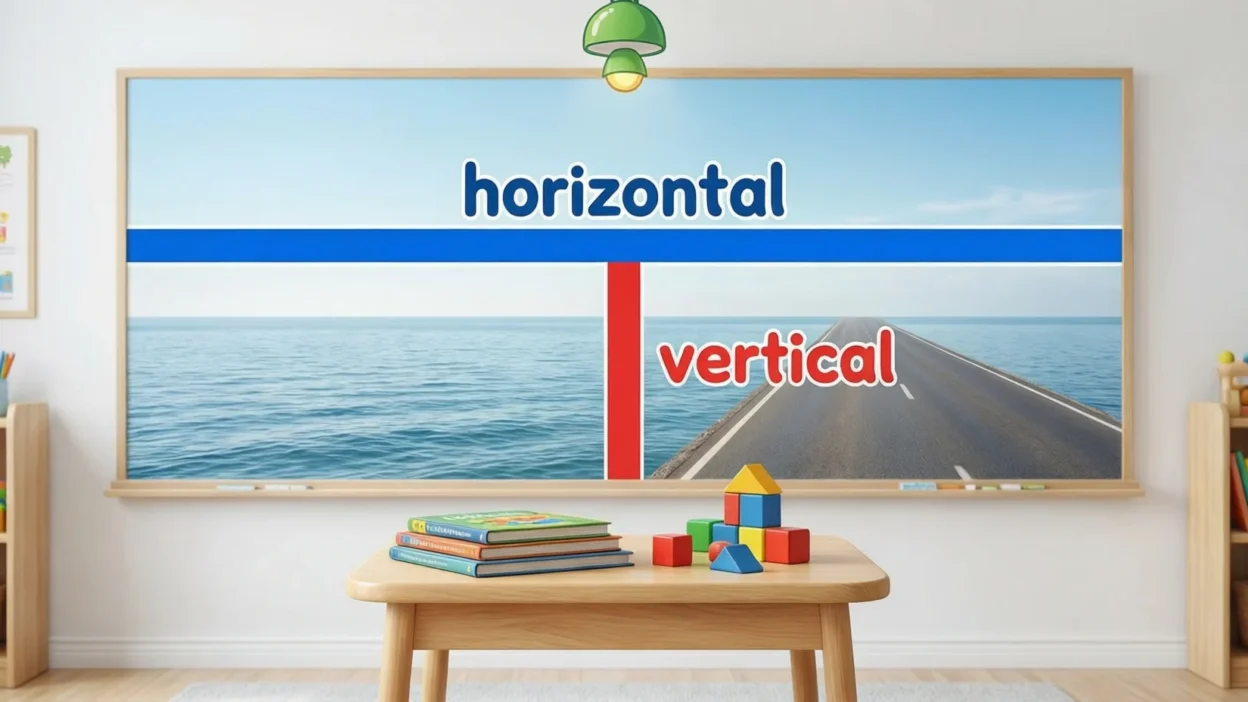
The word horizontal is simple, but many people want to understand it clearly. Students learn it in school. Artists use it in drawing. Builders use it in construction. We also see horizontal things in daily life, like roads, tables, and the horizon in nature.
In easy words, horizontal means flat or level, going from left to right. It does not go up or down.
In this article, you will learn:
- The meaning of horizontal
- What a horizontal line is
- The difference between horizontal and vertical
- Real-life examples
- Why it is important to learn
This guide uses simple language so everyone can understand.
Horizontal Meaning in Simple Words
Horizontal means flat or level. It goes side to side, not up and down.
Imagine looking at the sea. The line where the sky meets the water is called the horizon. That line is horizontal.
Another easy example is a table. The top of a table is flat. That surface is horizontal.
So, in simple words:
Horizontal = flat, level, or side to side
What Is a Horizontal Line?
A horizontal line is a straight line that goes from left to right. It does not slope up or down.
Students learn about horizontal lines in geometry, which is the study of shapes and lines.
Examples of horizontal lines:
- The edge of a book lying flat
- A calm sea horizon
- Lines in a notebook
A horizontal line always stays level.
Horizontal vs Vertical – What Is the Difference?
It is important to know the difference between horizontal and vertical.
Horizontal
- Goes left to right
- Flat or level
- Example: floor
Vertical
- Goes up and down
- Straight toward the sky or ground
- Example: wall
Think of the letter H in horizontal. The middle line in H is horizontal. The side lines are vertical.
There is also another type of line called a diagonal line. A diagonal line is slanted. It is not horizontal or vertical.
Horizontal in Geometry and Mathematics
In mathematics, horizontal lines are very important.
When students learn about graphs, they see a coordinate system. This system has two main lines:
- X-axis (horizontal)
- Y-axis (vertical)
The X-axis runs left to right. That makes it horizontal.
In geometry, horizontal lines can also be parallel lines. Parallel lines never meet. Many horizontal lines can be parallel to each other.
For example:
- Lines on notebook paper
- Lines on ruled charts
These are horizontal and parallel.
Real-Life Examples of Horizontal
Horizontal things are everywhere.
The Horizon
The horizon is one of the best examples. When you look far away, you see a flat line where the sky and land meet. That line is horizontal.
Ground Level
The ground we walk on is mostly horizontal. Floors in houses are also horizontal.
Flat Surfaces
Many flat surfaces are horizontal, such as:
- Tables
- Desks
- Beds
- Shelves
Landscape Orientation
When you hold a phone sideways to watch a video, it becomes landscape orientation. The screen is wider than tall, which matches the horizontal direction.
Horizontal Direction in Daily Life
We use horizontal ideas in many areas of life.
Drawing and Art
Artists draw horizontal lines to show calm scenes like oceans or fields. Horizontal lines often make pictures look peaceful.
Architecture and Buildings
Builders use tools to check if surfaces are level. Floors and roofs must be horizontal so buildings stay safe.
Screens and Technology
Televisions and computer monitors are usually wider than tall. They are designed in a horizontal layout.
Why Learning Horizontal Is Important for Students
Learning horizontal helps students in many subjects.
Mathematics
Students learn graphs, shapes, and lines. Horizontal lines are part of these lessons.
Geography
Maps use horizontal lines called latitude. These lines help us find places on Earth.
Drawing and Crafts
Students draw houses, landscapes, and objects. Horizontal lines help make pictures look real.
Understanding horizontal makes learning easier in many areas.
Horizontal in Nature
Nature gives many examples of horizontal lines.
Ocean and Lakes
Water in a calm lake forms a flat surface. That surface looks horizontal.
Fields and Plains
Large flat lands appear horizontal when viewed from far away.
Sunsets
At sunset, the sun moves along the horizon, which is a horizontal line.
Nature is one of the best teachers for understanding horizontal.
Horizontal in Everyday Objects
Look around your home or classroom. You will see many horizontal things.
Examples include:
- Tables
- Whiteboards
- Window edges
- Shelves
- Roads
Most objects that must hold items or support weight are designed to be horizontal.
Easy Ways to Identify Horizontal
Here are simple steps to recognize horizontal lines:
- Check if the line goes left to right.
- See if it looks flat or level.
- Notice if it does not go up or down.
If these are true, the line is horizontal.
Horizontal and Balance
Horizontal surfaces help keep things balanced.
For example:
- A tilted table can make items fall.
- A level shelf keeps books safe.
Builders and engineers use special tools called levels to make sure surfaces are horizontal.
This helps keep structures safe and strong.
Horizontal in Maps and the Earth
In geography, imaginary horizontal lines circle the Earth. These lines are called lines of latitude.
The most famous latitude line is the Equator. It is a horizontal line around the middle of the Earth.
These lines help us find locations and study climate.
Common Mistakes About Horizontal
Some people confuse horizontal with other directions.
Mistake 1: Thinking Flat Means Always Perfect
Some surfaces look flat but are slightly tilted. Builders use tools to check true horizontal levels.
Mistake 2: Mixing Horizontal and Diagonal
A slanted line is diagonal, not horizontal.
Mistake 3: Thinking Horizontal Means Wide Only
Horizontal does not mean wide. It means level from side to side.
Fun Activities to Learn Horizontal
Teachers and parents can help children learn with simple activities.
Activity 1: Find Horizontal Lines
Ask children to find five horizontal objects in a room.
Activity 2: Drawing Practice
Draw a house and add horizontal lines for the roof and floor.
Activity 3: Nature Observation
Look at the horizon during sunset and talk about its shape.
These activities make learning fun and easy.
Easy Tips to Remember Horizontal
Here are simple tricks:
- Think of the horizon in nature.
- Remember a table surface.
- Think of the letter H and its middle line.
These memory tricks help students remember quickly.
FAQs
Is the horizon always horizontal?
Yes, the horizon appears horizontal because it is level with the Earth’s surface from our view.
Is a road horizontal?
Most roads are built to be mostly horizontal so vehicles can move safely.
What is the opposite of horizontal?
The opposite of horizontal is vertical, which goes up and down.
Are notebook lines horizontal?
Yes, notebook lines are horizontal to help us write straight.
Conclusion
The meaning of horizontal is simple but very useful. Horizontal means flat, level, or side to side. We see horizontal lines in math, nature, buildings, and daily life.
From the horizon in nature to the X-axis in graphs, horizontal lines help us understand the world. Students, artists, and builders all use this idea every day.
Once you learn to recognize horizontal lines, you will start noticing them everywhere on tables, roads, screens, and landscapes.

Jack London is a versatile writer with a strong ability to explain ideas in a clear and engaging way.
He focuses on creating informative, easy-to-understand content for a wide range of readers.
Jack London currently writes helpful articles for repliesnest.com, delivering trustworthy and reader-friendly information.