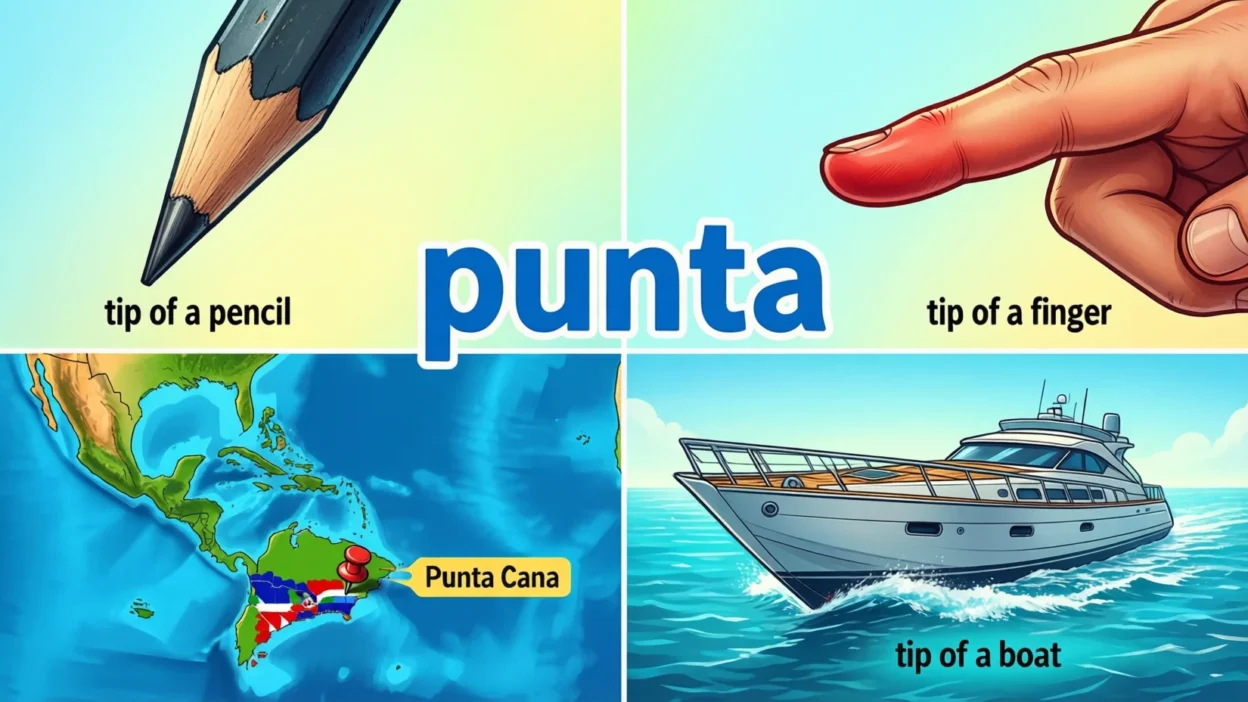
In Spanish, “punta” means tip, point, end, or peak. It is a feminine noun and has many uses in objects, anatomy, geography, and idioms.
The Spanish word “punta” is simple but very useful. It can mean the tip of a pencil, the end of a road, or even a place name. People learning Spanish often see it in different contexts, which can be confusing.
Understanding punta helps you read, write, and speak Spanish better. It also appears in expressions and idioms that are common in daily conversation. Knowing its meaning shows a deeper understanding of the Spanish language.
In this article, we will explain all the main meanings of punta, how it is used, common expressions, synonyms, and examples. You will also see how it appears in geography, anatomy, and everyday objects.
Basic Definition of “Punta”
Punta is a feminine noun. Its most common meanings are:
- Tip
- Point
- End
- Peak
- Extremity
Examples:
- La punta del lápiz está rota.
(The tip of the pencil is broken.) - Caminamos hasta la punta de la playa.
(We walked to the end of the beach.)
Synonyms: extremo, ápice, vértice, cima. These words are similar but may be used in formal or technical contexts.
Common Uses of “Punta”
Everyday Objects
Punta often refers to the tip of things we use daily. Examples include:
- Pencil: la punta del lápiz
- Knife: la punta del cuchillo
- Shoe: la punta del zapato
- Nail: la punta de la uña
Examples in sentences:
- Ten cuidado con la punta del cuchillo.
(Be careful with the tip of the knife.) - La punta de mi zapato se rompió.
(The tip of my shoe is broken.)
Anatomy
Punta can describe the tip of body parts:
- Finger: la punta del dedo
- Nose: la punta de la nariz
- Toe: la punta del pie
Example sentences:
- Me corté la punta del dedo.
(I cut the tip of my finger.) - Su punta de la nariz estaba roja por el frío.
(The tip of her nose was red from the cold.)
Geography & Place Names
In Spanish, punta is often used in place names. It usually refers to a land tip or cape. Examples:
- Punta Cana (Dominican Republic)
- Punta del Este (Uruguay)
- Punta Arenas (Chile)
Example sentence:
- Vamos a pasar las vacaciones en Punta Cana.
(We are going to spend vacation in Punta Cana.)
Nautical Terms
In boating and sailing, punta can mean the tip or front of a boat.
Example sentence:
- La punta del barco tocó la arena.
(The tip of the boat touched the sand.)
Idioms and Expressions with “Punta”
Punta appears in many common Spanish expressions.
A punta de
Means “by means of” or “on the verge of”.
- Luchó a punta de esfuerzo.
(He fought by means of effort.)
De punta en blanco
Means “dressed to the nines” or perfectly neat.
- Ella llegó de punta en blanco a la fiesta.
(She arrived dressed to the nines at the party.)
Other idioms may include:
- A punta de pistola – under threat or pressure.
- Al final de la punta – at the very end.
Synonyms and Related Words
Some words similar to punta include:
- Extremo – end, extremity (more formal)
- Ápice – apex, tip (often used in science or poetry)
- Cima – summit, peak (mountains or achievements)
- Vértice – vertex, corner (geometry or structures)
Example:
- La cima de la montaña está cubierta de nieve.
(The peak of the mountain is covered in snow.)
Use punta in everyday speech, and the other words in formal or specialized contexts.
How to Use “Punta” in Conversation
Here are tips to use punta correctly:
- Identify what you are describing – tip, end, or point.
- Use it with common nouns: lápiz, dedo, zapato, barco.
- Include idioms for more natural speech.
- Remember it is feminine: always use la punta.
Mini-dialogues:
- María: ¿Dónde está la punta del lápiz?
- Juan: Aquí está, se rompió.
- Pedro: Vamos a la punta de la playa.
- Ana: ¡Sí! Me encanta la vista desde allí.
Conclusion
The word “punta” is simple but powerful in Spanish. It can mean tip, point, end, or peak, and appears in objects, body parts, place names, and idioms. By learning its different meanings and expressions, you can improve your Spanish vocabulary and speak more naturally.
Remember to always use la punta and pay attention to the context. With practice, you will be able to understand and use punta confidently in everyday conversation, writing, and reading.
FAQs
Q1: What does “punta” mean in Spanish slang?
- Sometimes “punta” is used as slang for someone being rude or tricky, depending on region.
Q2: How do you pronounce “punta” correctly?
- Pronunciation: POON-tah (stress on the first syllable).
Q3: Can “punta” be used metaphorically?
- Yes. For example, “a la punta de sus fuerzas” means at the peak of their strength.
Q4: Is “punta” always feminine?
- Yes, it is always la punta, never masculine.
Q5: Examples of “punta” in literature or songs?
- “Llegó hasta la punta del cielo.” (Reached the tip of the sky) – poetic usage.

Josh Clark is an experienced writer known for producing well-researched and engaging content.
He specializes in simplifying complex topics into clear, reader-friendly explanations.
Josh Clark currently contributes informative articles to repliesnest.com, focusing on accuracy and value for readers.