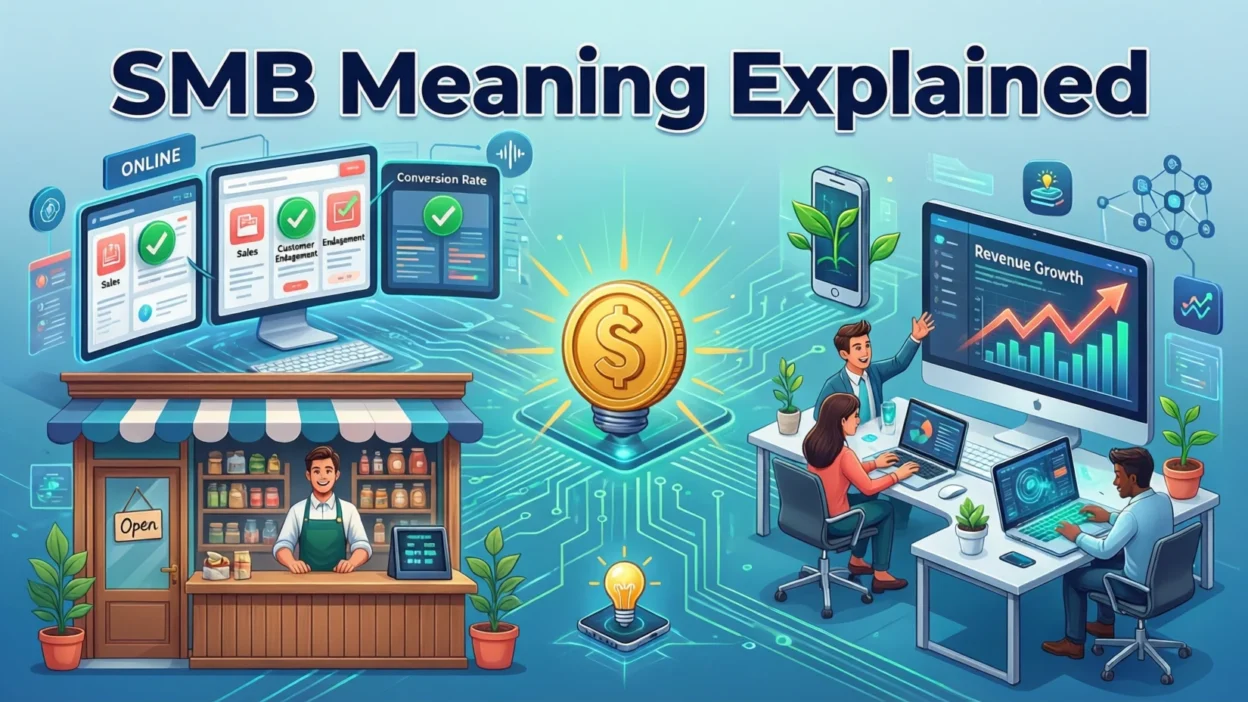
The term SMB is everywhere in business, marketing, and technology. But not everyone knows what it means.
SMB meaning refers to Small and Medium-sized Businesses. These are companies that are bigger than a tiny shop but smaller than a large corporation. SMBs include local shops, startups, online stores, and growing service companies.
Understanding SMB meaning helps you know how these businesses operate, how they use technology, and how they market themselves. It also shows why SMBs are so important for jobs, innovation, and the economy.
In this guide, we will explain SMB meaning in simple words, explore its types, tools, marketing strategies, and even its tech meaning.
What Does SMB Mean?
SMB means Small and Medium-sized Business.
It describes a business that is not very small, but also not very large.
An SMB usually has:
- Fewer employees
- Lower revenue than big companies
- Simple business structure
Example:
A local shop, a startup, or a growing online company can all be SMBs.
What Is an SMB in Simple Words?
An SMB is a business that:
- Is owned by one person or a small team
- Serves local or online customers
- Grows step by step
It sits between:
- A small business (very few employees)
- A large enterprise (thousands of employees)
SMB vs SME: Are They the Same?
Yes, mostly.
- SMB = Small and Medium-sized Business
- SME = Small and Medium-sized Enterprise
Both mean the same thing.
The difference is usage:
- SMB is common in the United States
- SME is common in Europe and Asia
How Is an SMB Defined?
There is no single global rule.
But most SMBs are defined by employees and revenue.
Employee Count in SMBs
Most SMBs fall into these groups:
- Micro business:
1–10 employees - Small business:
11–50 employees - Medium-sized business:
51–250 employees
If a company has thousands of employees, it is usually an enterprise, not an SMB.
Revenue of SMBs
Revenue also matters.
An SMB usually earns:
- Enough to grow
- But less than large corporations
Revenue limits change by:
- Country
- Industry
- Government rules
Industry-Based SMB Definition
An SMB can exist in almost any industry:
- Retail
- Manufacturing
- Technology
- Services
- Marketing
A tech startup with 20 employees is an SMB.
A local factory with 150 workers is also an SMB.
Why SMBs Are Important
SMBs are the backbone of the economy.
They matter because they:
Create Jobs
Most people work for small or medium businesses.
Support Local Communities
Local SMBs support:
- Neighborhoods
- Families
- Local markets
Drive Innovation
Many new ideas come from:
- Startups
- Small tech teams
- Creative entrepreneurs
Grow the Economy
When SMBs grow, the economy grows with them.
Common Types of SMBs
Not all SMBs are the same.
Local and Family Businesses
Examples:
- Grocery stores
- Repair shops
- Restaurants
- Small factories
These businesses:
- Serve local customers
- Create local jobs
Online and Digital SMBs
Examples:
- E-commerce stores
- Freelance agencies
- Online service providers
They often use:
- Websites
- Social media
- Digital marketing
B2B and B2C SMBs
B2B (Business to Business):
- Sell to other businesses
- Example: software companies
B2C (Business to Consumer):
- Sell to customers
- Example: online shops
Both types can be SMBs.
What Does SMB Mean in Technology?
In technology, SMB has another meaning.
It can stand for Server Message Block.
What Is Server Message Block?
Server Message Block (SMB) is a network protocol.
It allows computers to:
- Share files
- Share printers
- Communicate on a local network
Where Is SMB Protocol Used?
SMB is mostly used in:
- Microsoft Windows systems
- Office networks
- Business IT setups
It works on:
- LAN (Local Area Network)
- NAS (Network Attached Storage)
Why SMB Protocol Matters for Businesses
The SMB protocol helps businesses:
- Share data safely
- Manage files
- Improve teamwork
Many SMB companies rely on it every day.
SMB in Marketing: What Does It Mean?
In marketing, SMB refers to small and medium business marketing.
SMB marketing is different from big-brand marketing.
What Is SMB Marketing?
SMB marketing focuses on:
- Low budgets
- High impact
- Local or targeted audiences
It is more personal and flexible.
Best Marketing Channels for SMBs
Most SMBs use:
SEO for SMBs
- Helps websites rank on Google
- Brings free traffic
Email Marketing
- Low cost
- Direct communication
Social Media Marketing
Local Marketing
- Google Business Profile
- Local ads
Lead Generation for SMBs
Lead generation means:
- Finding new customers
SMBs use:
- Contact forms
- Email signups
- Social media messages
SMB Sales Models
SMBs sell in different ways:
- Direct sales
- Online sales
- Service-based selling
They focus on:
- Customer trust
- Long-term relationships
Tools and Software Used by SMBs
SMBs depend on simple and smart tools.
Business Management Tools
Common tools include:
- Accounting software
- Payroll systems
- CRM (Customer Relationship Management)
These tools help manage:
- Money
- Employees
- Customers
Technology Tools for SMBs
Many SMBs use:
- Cloud services
- Cybersecurity tools
- Basic IT infrastructure
These tools keep data safe and work smooth.
SMB Finance and Operations
Money management is very important for SMBs.
Cash Flow Management
Cash flow means:
- Money coming in
- Money going out
Good cash flow keeps a business alive.
Business Loans and Funding
SMBs often use:
- Business loans
- Small investments
- Government programs
These help with growth and scaling.
Tax Compliance
SMBs must:
- Pay taxes
- Follow local rules
Simple systems help avoid problems.
Scaling Operations
As SMBs grow, they:
- Hire more employees
- Use better tools
- Expand markets
Growth must be planned carefully.
Challenges Faced by SMBs
SMBs face many challenges.
Limited Resources
They often have:
- Small budgets
- Small teams
Competition
Large enterprises have:
- More money
- Bigger marketing power
SMBs compete with:
- Smart strategies
- Personal service
Technology Adoption
New tech can be:
- Expensive
- Hard to learn
But it is necessary for growth.
Hiring Skilled Employees
Finding good workers is a challenge for many SMBs.
SMB vs Enterprise: Key Differences
| Feature | SMB | Enterprise |
|---|---|---|
| Employees | Few to hundreds | Thousands |
| Revenue | Limited | Very high |
| Structure | Simple | Complex |
| Flexibility | High | Low |
| Decision Speed | Fast | Slow |
When Should You Use the Term SMB?
Use SMB when talking about:
- Business size
- Marketing strategies
- Technology solutions
- Finance and operations
It helps define the target audience clearly.
Is SMB Only for Small Companies?
No.
SMB includes:
- Small businesses
- Medium-sized businesses
It does not include:
- Large enterprises
- Multinational corporations
Conclusion
SMBs are the backbone of the economy. They create jobs, bring new ideas, and help communities grow.
Now that you understand SMB meaning, you can see the difference between small, medium, and large businesses. You also know how SMBs use technology, marketing, and tools to succeed.
Whether you are a business owner, marketer, or student, knowing SMB meaning helps you make smarter decisions, connect with the right businesses, and understand the world of small and medium enterprises better.
FAQs
What does SMB mean in business?
SMB means Small and Medium-sized Business.
What does SMB mean in technology?
It can mean Server Message Block, a file-sharing protocol.
How many employees does an SMB have?
Usually between 1 and 250 employees.
Are startups SMBs?
Yes, most startups are SMBs.
Why are SMBs important?
They create jobs, support communities, and grow the economy.
Is SMB the same as SME?
Yes, they mean almost the same thing.

Clara Brant is a skilled content writer known for creating clear, engaging, and reader-focused articles.
She specializes in informative and practical topics that help users find quick, reliable answers.
Clara currently contributes high-quality content to repliesnest.com, focusing on accuracy and readability.