Learning how to say sorry in French is a simple yet meaningful way to connect with people and show good manners. Whether you bump into someone or make a big mistake, knowing the right apology makes a huge difference. French offers many polite and heartfelt ways to say sorry — from désolé to je m’excuse — that help you sound more natural and respectful in any situation.
Each phrase carries a touch of French culture, where politeness and tone matter a lot. So, let’s explore how to express your apologies the French way — with sincerity, charm, and a little elegance!
Sorry in French
Let’s explore 15 easy and useful ways to say sorry in French with examples and meanings.
15 French Phrases for Saying Sorry
| # | French Phrase | English Meaning | Use |
|---|---|---|---|
| 1 | Désolé(e) | Sorry | General apology |
| 2 | Pardon | Excuse me / Sorry | Everyday use |
| 3 | Excusez-moi | Excuse me (formal) | Polite settings |
| 4 | Excuse-moi | Sorry (informal) | Friends/family |
| 5 | Je suis désolé(e) | I’m sorry | Sincere apology |
| 6 | Je m’excuse | I apologize | Moderate apology |
| 7 | Je vous présente mes excuses | I offer my apologies | Formal/professional |
| 8 | Toutes mes excuses | All my apologies | Polite and formal |
| 9 | Désolé du dérangement | Sorry for the inconvenience | Customer service |
| 10 | Désolé d’être en retard | Sorry for being late | Everyday use |
| 11 | Désolé pour ça | Sorry about that | Casual |
| 12 | Je regrette | I regret | Deep regret |
| 13 | Veuillez m’excuser | Please excuse me | Formal writing |
| 14 | Je suis navré(e) | I’m terribly sorry | Serious apology |
| 15 | Je te demande pardon | I ask for forgiveness | Emotional/sincere |
1. Désolé / Désolée – “Sorry”

Origin: From Latin desolatus meaning “to be saddened or distressed.”
Example: Je suis désolé pour le retard.
(I’m sorry for the delay.)
Use: Common and heartfelt. Add “Je suis” for a stronger, more emotional apology.
2. Pardon – “Excuse me” / “Sorry”
Origin: From Latin perdonare meaning “to forgive.”
Example: Pardon, je ne t’ai pas vu !
(Sorry, I didn’t see you!)
Use: Polite and everyday word; used for small mistakes or when bumping into someone.
3. Excusez-moi – “Excuse me” (formal)

Origin: From the French verb excuser, meaning “to excuse.”
Example: Excusez-moi, madame, je suis en retard.
(Excuse me, ma’am, I’m late.)
Use: Polite and formal; perfect for speaking to strangers or elders.
4. Excuse-moi – “Sorry” (informal)
Origin: Comes from the French word excuser, meaning “to forgive or excuse.”
Example: Excuse-moi, je ne voulais pas te blesser.
(Sorry, I didn’t mean to hurt you.)
Use: Casual and friendly; used with friends, family, or people you know well.
5. Je suis désolé(e) – “I’m sorry”
Origin: From désoler, meaning “to distress” or “to make sad.”
Example: Je suis désolée de t’avoir fait attendre.
(I’m sorry for making you wait.)
Use: Deep and emotional; can be formal or casual depending on tone.
6. Je m’excuse – “I apologize”

Origin: Derived from Latin excausare meaning “to free from blame.”
Example: Je m’excuse pour la confusion.
(I apologize for the confusion.)
Use: Common in everyday speech; polite but slightly less formal than Je vous présente mes excuses.
7. Je vous présente mes excuses – “I offer my apologies”
Origin: Used in 18th-century diplomatic French to show high respect and sincerity.
Example: Je vous présente mes excuses pour le retard.
(I offer my apologies for the delay.)
Use: Very formal; best for business, emails, or official apologies.
8. Toutes mes excuses – “All my apologies”
Origin: From traditional French letter-writing culture expressing humility and politeness.
Example: Toutes mes excuses pour ce malentendu.
(All my apologies for this misunderstanding.)
Use: Sincere and respectful; suitable for professional or polite contexts.
9. Désolé du dérangement – “Sorry for the inconvenience”
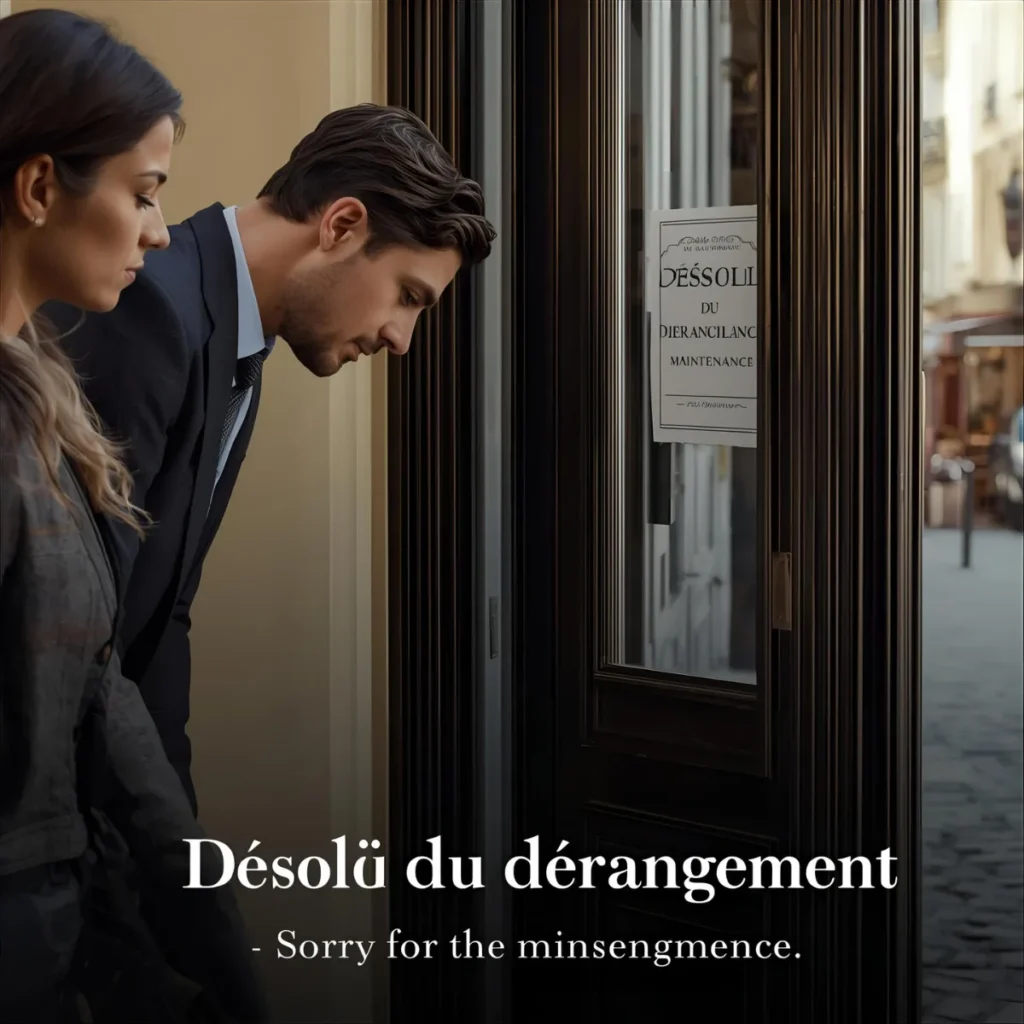
Origin: Combines désolé (sorry) and dérangement (disturbance); widely used in public service.
Example: Désolé du dérangement, monsieur.
(Sorry for the inconvenience, sir.)
Use: Polite and professional; ideal in customer service or formal situations.
10. Désolé d’être en retard – “Sorry for being late”
Origin: Formed from désolé and retard (delay); reflects French punctuality values.
Example: Désolé d’être en retard, il y avait du trafic.
(Sorry for being late, there was traffic.)
Use: Common phrase for daily life; suitable in both friendly and polite situations.
11. Désolé pour ça – “Sorry about that”
Origin: Shortened modern form of désolé pour cela; simplified in spoken French.
Example: Oh, désolé pour ça !
(Oh, sorry about that!)
Use: Informal and friendly; perfect for minor mistakes or quick apologies.
12. Je regrette – “I regret”
Origin: From Old French regreter and Latin regrettare, meaning “to feel sorrow again.”
Example: Je regrette ce que j’ai dit.
(I regret what I said.)
Use: Expresses deep remorse; formal and emotional.
13. Veuillez m’excuser – “Please excuse me”
Origin: Combines polite imperative veuillez (“please do”) with m’excuser (“excuse me”).
Example: Veuillez m’excuser pour le dérangement.
(Please excuse me for the inconvenience.)
Use: Very formal; great for professional communication, emails, or public speaking.
14. Je suis navré(e) – “I’m terribly sorry”
Origin: From Old French navrer meaning “to wound.”
Example: Je suis navré pour votre perte.
(I’m terribly sorry for your loss.)
Use: Deeply emotional; used in serious, sensitive, or sad situations.
15. Je te demande pardon – “I ask for your forgiveness”

Origin: From demander (“to ask”) and pardon (forgiveness); linked to Latin perdonare (“to fully forgive”).
Example: Je te demande pardon pour tout.
(I ask for your forgiveness for everything.)
Use: Very sincere and emotional; used for heartfelt apologies and reconciliation.
FAQs:
1. What is the most common way to say sorry in French?
The most common way to say sorry in French is “Désolé” (for men) or “Désolée” (for women).
2. How do you apologize politely in French?
Use “Je vous prie de m’excuser” or “Veuillez m’excuser.” Both are formal and polite.
3. What’s the difference between “Pardon” and “Désolé”?
“Pardon” is for small mistakes; “Désolé” shows deeper regret or emotion.
4. How do you say “I’m really sorry” in French?
Say “Je suis vraiment désolé(e)” to show more sincerity.
5. How do French people respond to an apology?
Common replies include “Ce n’est pas grave” (It’s okay) and “Pas de problème” (No problem).
Conclusion:
Saying sorry in French is more than just learning words — it’s about understanding culture and emotion. Whether you use pardon, désolé, or je suis navré, every phrase helps you express kindness and respect. The more you practice, the more natural your apologies will sound in real conversations. So next time, say it with confidence — and a smile. 🌷

Liam Bennett is a dedicated content writer who creates clear, engaging, and well-structured articles.
He focuses on delivering practical information that is easy for readers to understand and apply.
Liam Bennett currently writes high-quality content for repliesnest.com, ensuring clarity and reliability.