Have you ever wondered, “what does valid mean?” You might see it in school, in the law, or even in everyday life. But the word can feel tricky. In this guide, we will explain valid in simple words. You will also learn how to use it in different situations.
What Is the Meaning of Valid?
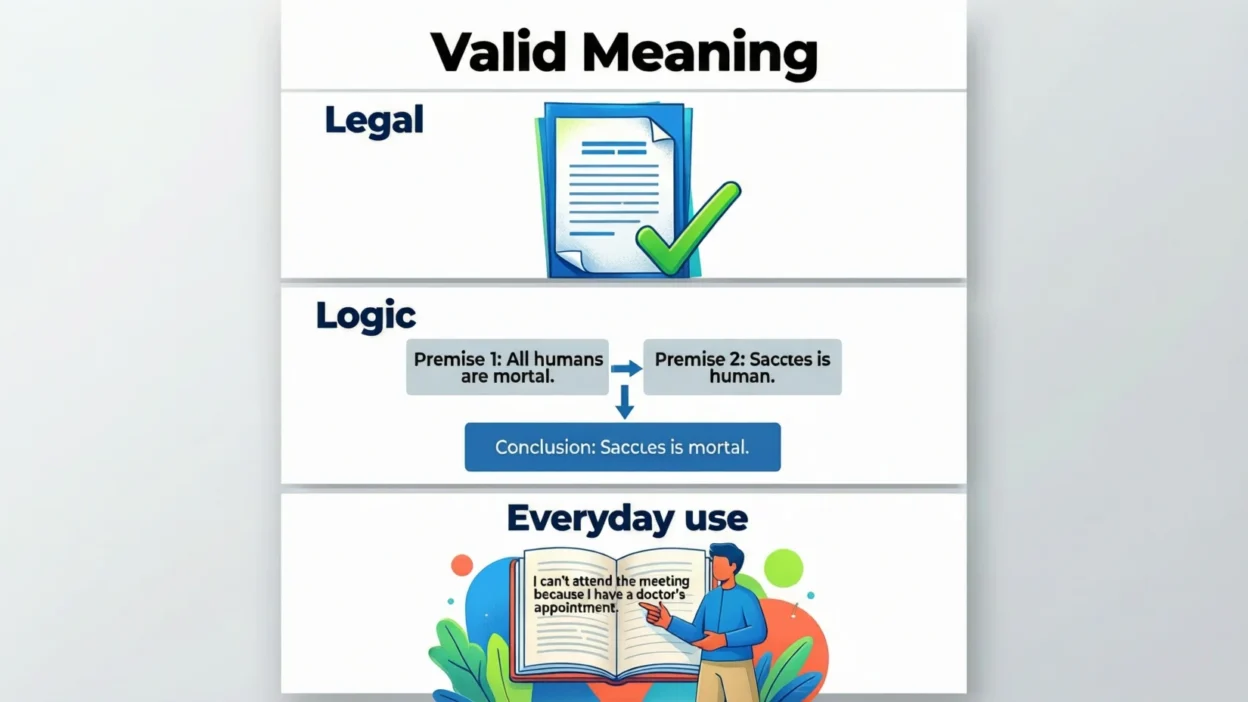
The word valid is an adjective. It means something is correct, acceptable, or legally right.
- In law, valid means it follows the rules.
- In logic, valid means it makes sense.
- In everyday life, valid means reasonable or fair.
Example sentences:
- “Your ticket is valid for the whole month.”
- “He gave a valid reason for missing class.”
- “This is a valid argument in math.”
In short, valid shows that something works or is allowed.
Different Contexts of Valid
1. Legal Context
In the law, valid is very important. A document, contract, or license must be valid to be used.
What makes it valid?
- It must follow the law.
- It must be fair and clear.
- It must be signed or approved when needed.
Example:
- “A valid contract must have two people agreeing to it and a legal purpose.”
If a contract is not valid, it cannot be enforced in court.
2. Logical Context
In logic and reasoning, valid means that the conclusion follows the facts.
Example:
- Premise: “All humans need water.”
- Premise: “Ali is a human.”
- Conclusion: “Ali needs water.”
This is a valid argument because the conclusion follows the facts.
Tip: An argument can be valid but not true if one of the facts is wrong.
3. Everyday Use
We use valid every day without thinking about logic or law. It can mean a good reason or excuse.
Examples:
- “Your reason for being late is valid.”
- “That is a valid point in the discussion.”
Here, valid means fair, reasonable, or correct.
Synonyms of Valid
Synonyms are words that mean almost the same as valid.
- Legitimate → Allowed by law or rules.
- Lawful → Correct under the law.
- Correct → Free from mistakes.
- Acceptable → Good enough to be allowed.
- Credible → Can be trusted.
- Well-founded → Based on facts or logic.
Example sentences with synonyms:
- “This is a legitimate reason to skip class.”
- “The ID is lawful and can be used.”
- “Your argument is well-founded and makes sense.”
Antonyms of Valid
The opposite of valid is invalid. Other antonyms include:
- Incorrect
- Illegitimate
- Unacceptable
Example sentences:
- “This ticket is invalid because it is expired.”
- “The argument is incorrect and does not make sense.”
Knowing antonyms helps you understand when valid should or should not be used.
How to Use “Valid” Correctly
Using valid is easy once you know the rules:
- Legal Use: “A valid passport is required to travel.”
- Logical Use: “Your reasoning is valid, but your facts are wrong.”
- Everyday Use: “That is a valid excuse for being late.”
Common mistakes:
- Do not use valid for emotions. ❌ “I feel valid” → ❌ Wrong
- Do not use valid for personal opinions without proof. ❌
Tip: Use valid for facts, reasons, or official things, not feelings.
Examples of Valid in Different Contexts
- School:
- “Your homework submission is valid.”
- Travel:
- “The ticket is valid for three days.”
- Business:
- “The contract is valid and binding.”
- Logic/Math:
- “The argument is valid, and the solution is correct.”
Conclusion
The word valid is simple but powerful. It tells us that something is correct, fair, or acceptable. We use it in law, logic, and daily life. Knowing valid and its synonyms like legitimate, lawful, and well-founded will help you communicate better.
Next time you see valid, think: is it correct, reasonable, or allowed? That’s all it takes!
FAQs
1. What is the meaning of valid?
- Valid means correct, acceptable, or allowed.
2. How is “valid” used in legal terms?
- It refers to contracts, licenses, or documents that follow the law.
3. What is the difference between valid and legitimate?
- Valid can refer to law, logic, or reasoning.
- Legitimate usually refers to law or rules only.
4. Can an argument be valid but not true?
- Yes. The argument can follow logic but start with wrong facts.
5. What is the opposite of valid?
- The opposite is invalid, meaning not correct, legal, or acceptable.

Mark Twain was a legendary American writer known for his wit, storytelling, and timeless insights.
His works continue to educate and entertain readers through clear observations on life and society.
Selected writings and educational references to his work are featured on repliesnest.com.